Showing posts with label Israel/Palestine. Show all posts

Tuesday, November 25, 2014

having hope

I had something else I was going to write, but I spent my morning listening to the news, and what else can I think about but the grand jury decision in Ferguson.   The pain, the anger, the fear, the sorrow, the uncertainty, the distrust.  I feel like it is something that happened to all of us, not just to the people in Ferguson.  

What it is bringing to mind is a talk I went to on campus last week.  Dr. Izzeldin Abuelaish is a Palestinian doctor who has the distinction of being the first Palestinian doctor to receive an appointment at an Israeli hospital.  He has much he could talk about, but the title of his talk (and his book) is I Shall Not Hate: A Gaza Doctor's Journey.

He has good reason to hate.  In 2009, during the Gaza war, his house was bombed.  He lost three of his daughters and a niece.  His fourth daughter suffered the loss of an eye and two fingers.

Pain. Anger. Deep sorrow.

His journey has been one about continuing the story, initiating discussion, keeping the memories of his daughters alive.  How many of us could manage to rise above our humanity to carry on in such a loving way? 

Dr. Abuelaish was talking to a sympathetic audience, but there was a large police presence in the auditorium.  It is dangerous to talk about love and peace. It is dangerous to have hope.

Wednesday, November 19, 2014

Maybe probably

There is some seriously old stuff in Israel.  When I traveled there with my family in 1987, the visits to churches and historical or biblical sites seemed boring and endless - rocks, rocks, more rocks, too many people in large buses, and...rocks.  My excuse for this irreverent remembrance is that I was seventeen and much more interested in the present and the future - and frankly, myself - than in anything that happened forever ago.

Before I left on my trip, Dan and I had lunch at a Jordanian restaurant uptown, a joint that serves good falafel and shwarma.  The owner strolled up to us towards the end of our meal and said he'd just made some tea flavored with cardamom and sage, and would we care for a cup? We pushed aside our plastic baskets with the remains of our falafel and fries to make room for china tea cups and a small tray holding sugar and spoons.  We told our host where I was headed, and his response was to exclaim, "Why God does this? Why does everything have to happen in such a small place? Everything important in one place? Why not Mohammed in Argentina, Jesus in Alaska? It makes things so difficult.  So difficult and so beautiful."

It does make things so difficult. And it is also what makes "the holy lands" so interesting.  Our extremely knowledgeable driver, George, liked to point out all the ways in which the Jews, Muslims and Christians are "cousins" - the ritual bathing, the prayers, the holy sites themselves, the ancient stories.  He also prompted our personal tour guide, Bonnie, about all the places where "maybe probably" stories from the Bible occurred.  "Here is where maybe probably Jesus spoke to the fishermen."  We saw places where Jesus maybeprobably walked, preached, lived...What astounded me was not so much that it might have been Jesus maybeprobably doing those things, but that we could visit places where people of a time much farther ago than the first century BC walked, sat and lived their lives. Not maybeprobably, but definitely. Israel is a dry country of stone, and though stone can be covered by sand and dirt, it does not deteriorate very quickly, and so much of what was still is!

Jericho

In Jericho we visited Tell es-Sultan - where one city has been built upon another city has been built upon another city - and the earliest area to be excavated had walls of what is thought to be a neolithic home.  Walls. I could imagine someone sitting and resting against those walls, in out of the blazing sun, 10,000 years ago. Living their human lives in the oldest city in the world.

Jericho
When we traveled to the north end of the Sea of Galilee we visited a place where a new hotel was to be built.  Before any construction begins, the site must be preliminarily excavated to a certain extent to make sure nothing awesome is being destroyed in the process, and by awesome I mean Really Old. In this instance, the would-be hoteliers discovered a first-century synagogue, and a market place, and a ritual bath called a mikvah that is believed to be the ancient city of Magdala, on the shores of Galilee.  Magdala, as in Mary of Magdalene.

We had an impromptu tour of the site by one of the volunteers working on the site (you too can travel there and take part in the excavation!) who explained the particular significance of the carvings uncovered in the synagogue, but what caught my imagination were the baths.  When they were discovered and excavated, there was a moment when stones were removed that held back the mountain spring that originally filled the bath.  With the stones gone, the water flowed again, filling the baths.  Seeing the steps descending into the water, I was moved to imagine the mothers and grandmothers using those steps, performing their cleansing.  Living their lives.


The Sea of Galilee is replete with maybeprobablies.  At Tabgha there is the church of the multiplication, where the famous story of the loaves and the fishes is to have taken place.  There is a church called Peter's Primacy where Jesus called Peter to lead the church.  There is a beautiful church and convent on the Mount of the Beatitudes...


Tabgha - mosaic on the floor of the church
Peter's Primacy
 At the church of Peter's Primacy we were able to step into the lake, which was cool on our hottest day so far.  We waded past a large group of rambunctious teenagers, and paused to watch a feisty  Franciscan monk shoo a young woman in a bikini from the water.  She somehow missed all of the signs about modesty in a holy place...

We got to talking to this group of young people, and found out that they were Palestinians from the Diyar school in Bethlehem, "out" from behind the wall on a day pass for the holy week!  One sixteen year old we spoke with said that it was the first time she was out of the West Bank in 10 years.

   "It does not make sense that I should need permission, a pass, to come to my home, but I have the attitude of have joy with your day, live for today."

What a total pleasure it was to watch these kids be kids, splashing each other and enjoying their moment of freedom.


We ended this day up on the Mount of Beatitudes, which gave us a beautiful if hazy view of the lake.

Galilee, with view of Tabgha and Capernaum on the lakeshore

By this time I was more interested in the lizards playing in the garden and the brilliant metallic-blue hummingbirds in the trees than I was in fighting my way into another church full of pilgrims.

fellow weary travellers


The peaceful garden was the perfect balance to the pace of the day.


And I was clearly more interested in the human ironies of our surroundings than I was in the artifacts. But one more maybeprobably to share today.  This night we spent on the shore of the lake at Nof Ginosar kibbutz, which houses a museum that has a first century wooden boat!  The boat surfaced from the muddy bottom of the lake during a drought year, and was carefully preserved.  It is made of 16 different kinds of wood, probably salvaged from many other boats, and is from a time when Jesus maybeprobably was looking for fishers of men...


My pictures of this are all so very fuzzy, but, like those steps in Madgala, this ancient boat caught my imagination, and the maybeprobablies became a little more real.


I have posted several reflections on our trip to Palestine and Israel.  You can see them on the page titled Stories of Palestine.

I am posting every day in November.  Enjoy!

Thursday, November 13, 2014

Jerusalem

There was an awkward moment one afternoon this fall when my friend Savannah asked me, "So, have you been to Jerusalem?"  I took a quick surprised breath and held it, my mind instantly accessing smells and sounds of one of the most amazing places I've ever been - and then realized that she was talking about a new local restaurant, and released it all in a puff. Gone.

I went to Jerusalem with my parents when I was seventeen and what I knew about it then would have all come from Sunday School; somehow, for all of the international living I had done, I was not very up on my current events.  It is embarrassing to say this now, but I was naive enough to wear my red and white checkered kaffiyeh on the airplane, which got me pulled aside and questioned apart from my parents for an uncomfortably long time.  I understand now that I would have fit the profile of a PLO sympathizer, which is to say I was young and energetic, it was the 1980's, and I was traveling to the Middle East.


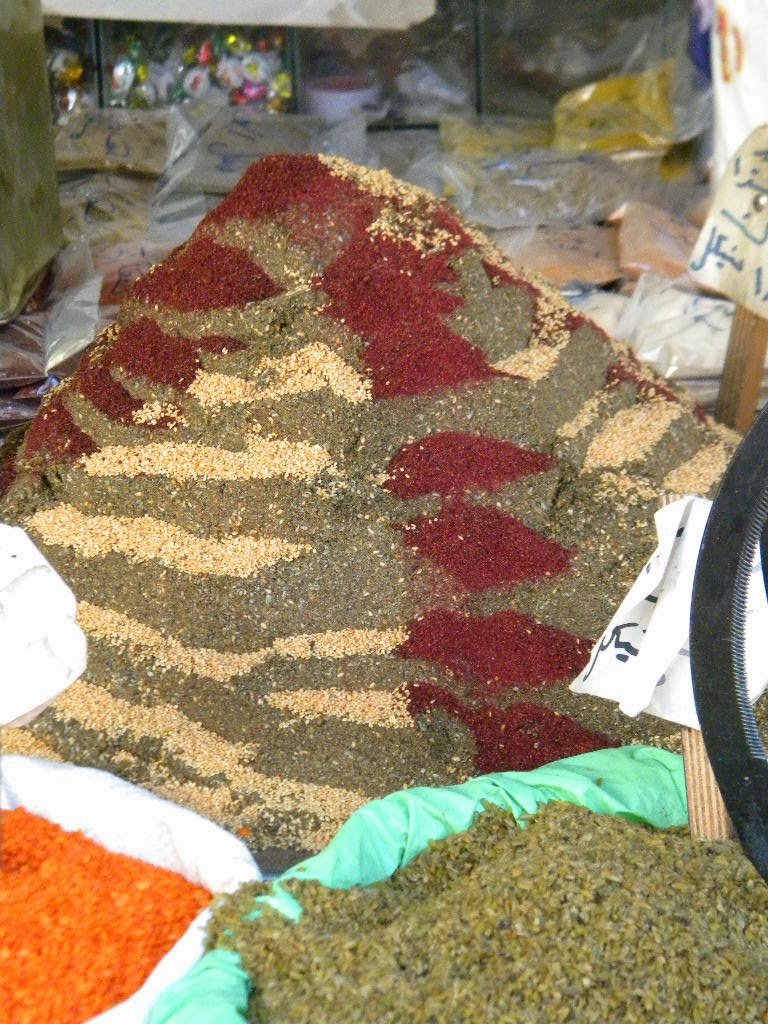
My visit that year was filled with sensory experiences: smelling the suqs, the mixtures of spices in open barrels and baskets, the mixture of humans, hearing the wide variety of sounds, the shopkeepers, the imam's call to prayer, the music winding out of shops into the narrow streets.  I remember Armenian pizza and the hummous against which all other hummous will be judged. I was also a senior in highschool and it was a challenging time for my family; my memories of those days are mostly vivid, flashes of color and light - a rooftop meal, rows and rows of scarves, the ride through stark desert to Jericho - and being so self-absorbed, I don't think I went home with any better understanding or impression of what life might have been like for someone living in Jerusalem. But I remembered the smells.


Fast forward twenty-six years, and standing on the top of the Austrian Hospice, near the Damascus gate in the old city of Jerusalem, the smells have not changed.  There is a busy intersection of streets in front of the hotel, and a minaret directly outside our bedroom window.  I have that cocktail of feelings that is equal parts excitement, joy, and deep sadness.  I cannot believe I am here again, that I am so fortunate to return to such a place; every particle of what I see, hear and smell brings me to life and I feel such contentment.

The sadness is how I experience most happy things in my life: I know I will feel your absence so much more for how happy being with you makes me.  Your presence represents your absence.  I know - can I just say that it runs in the family, just a bit? The sadness comes from knowing how short my time here is.  How can I leave a place that has so much life in its walls?


This trip also is buzzing with information that is new to me.  I spent the previous nine months reading as much as I could about "the situation" in Israel and Palestine, and as with most things, the things I know illuminate how much I can't possibly know, but my experience this time around goes so much deeper than my senses.  Now when I look at someone I want to know where they stand, what their story is, what are their struggles and their hopes for this place.  I can't get enough of the stories, from our guide, from our driver, from the women we've come to meet, from the women who have travelled here before. I try to situate myself on the bus near the women who I know will want to talk about it all with me, who will indulge my need to process everything, to ask questions or feel my feelings.

Our guides on this trip - two women who have been here many times before - have crafted an amazing experience for us.  They are aware of how much new information we are taking in, not just with our minds but experientially.  We tour so many churches and ruins that we laugh about how on the next trip they should issue temporary tattoos of the timeline of conquerors, represented clearly in the levels of stone built upon stone: Canaanite, Israelite, Babylonian Exile, Persian, Hellenistic, Roman, Byzantine, Early Muslim, Crusaders, Mamluk, Ottoman, British, State of Israel...Imagine, 3300 BCE to 1948 on the inside of my forearm for easy referencing.  We experience Hebron together for the first time, and they are careful to balance what they know will be an intense day in the middle of a Palestinian city pockmarked with Israeli settlements (they didn't know how intense) with a visit to a beautiful glass and ceramics factory.  Our day ends in a restaurant straight out of a movie, with tables full of baba ganoush, dishes of olives, baskets of pita bread, tabouleh, hummous, dolmas, Cremisan wine.  We have a chance to laugh at each other, trying the "hubbly bubbly", and it brings some balance to the horrors of the morning.


Our visit to the Wailing Wall of the Temple Mount is intense.  On a sensory level, it is unsettling after wandering the narrow streets and covered markets to enter such an open, vulnerable place as the square next to the wall.  I feel exposed and aware of the soldiers roaming everywhere.  One has to go through metal detectors and have passports at the ready before entering the area, which feels invasive and heightens the sense of vulnerability.  After all we've seen and heard on our trip, it is overwhelming to be standing in this place, the wall of the old temple.  How many people have prayed here? What does it mean that people still come from all over the world to place their hands on this wall and pray, whispering, crying, spending their brief moment touching the stone with their eyes closed before being gently pushed aside for the next wave of visitors?


From there we continue up to the Temple Mount and the Al-Aqsa Mosque.  The atmosphere is light - there are children playing ball, and several picnics scattered around the wide, park-like space.  


at the Al-Aqsa Mosque


One night in Jerusalem we have had a wonderful evening with Dalia Landau, the subject of the book The Lemon Tree.  It has been another full, emotional day, and by 10:30 most of us are in bed.   I am getting ready for bed, but can hear some commotion in the street below our window.  We have ornate grates on our windows, which are beautiful, but I am frustrated to not be able to open the window and look down to see what is going on.  Finally, I can't stand it, and as my mother reaches to put down her book and turn off the light, she notices that I am jamming my legs back into the pants I wore all day, and am fumbling for my shoes.  She knows I'm as tired as she is, and she's worried about me wandering out into the streets alone but I say, "Mom! I was an anthropology major! It's killing me sitting inside while there is something going on out there with all these people!!" I don't have to go far.  Leaning over the garden wall I can see a congregation of Ethiopian Orthodox, drumming, dancing, singing.  (It is close to 11:00 at night, and there is also a jack-hammer pounding away next to the jubilation!)


My brain is expanding so quickly, and my understanding.  I hold just the smallest thread of the story, wrapped around my palm and now when I think about Jerusalem - even when I visit the little hole-in-the-wall with this mighty name - there is so much that floods my mind.  The orthodox men, in their black hats and long coats, passing brightly clothed Muslim women with headscarves; the young Ethiopian men greeting each other by bumping shoulders, a sort of full-body high-five; the illusion that Jerusalem is a city that teems with peaceful diversity, shared by people with deep faith.  I see the young - they are so young - Israeli soldiers clustered on the rooftops, machine guns in their laps, always watching.  I know that while there is deep faith, there is also deep division, though the celebratory atmosphere of Orthodox Easter makes it seem that all is lively and well for the moment.


It has been a year and a half since we took this trip, and I'm still processing so much about it.  For other posts about this trip and a list of books and movies, please visit this page: Stories about Palestine.

This post is another in my attempt to paper November with my writing and photos!

Wednesday, March 19, 2014

Contain both sides in your heart

(this post is a part of a series of stories from a trip I took with my mother and nine other women to Israel and Palestine in April 2013)

One evening found us back at the Austrian Hospice in the old city of Jerusalem, sitting at table with Dalia Landau, who lead  us through a Shabbat Seder - a ceremony that welcomes the Queen, or the feminine divine through song and prayer.  Dalia is the subject of The Lemon Tree by Sandy Tolan, which tells the story of her discovery that her adopted family home, in Ramle, Israel, was the family home of Palestinians who were forced out in 1948.  Her family were Jews who fled to Israel from Bulgaria.  As a teenager, she met the boy who grew up in that house, and their families have together turned it into a peace education center for Jews and Muslims, called the Open House Center.


This Seder was one of the most moving moments of this trip for me (and with all we saw that is saying a lot!).  We had heard so much about politics and dividing lines, that to sit in prayer and ceremony together felt like peeling away the machine guns and surveillance cameras, the wall, the barbed wire, and getting back to something living and divine.  


We washed each others' hands, sang together, broke bread and drank wine, doing our Midwestern best to sing the beautiful Hebrew prayers.  It was part ceremony and part theology.  Dalia talked about the Torah as being both a book and the discussion that continues, not something to be taken literally; a text to be held up to constant interpretation.  


As we finished our evening with tea and apfel strudel, Dalia encouraged us to confront our prejudices and keep open hearts and minds.  

If you are pro-something, you are against the other side.  

If you cannot contain both sides in your heart, you are a part of the oppression.  

Shabbat Shalom!

Tuesday, December 10, 2013

Connecting at the Checkpoints: meeting with Machsom Watch

I came across a story from the New York Times  last month that was published a couple of years ago but was still a shot of light in the continuing struggle that is Israel.  This story of civil disobedience - Israeli and Palestinian women risking criminal charges to travel together outside of the West Bank to swim in the Mediterranean - put in my mind two women I haven't yet talked about from the trip I took in April to Palestine and Israel.  Here is a story about the first.


We met Yael, a member of Machsom Watch, at a checkpoint between Bethlehem and Jersusalem in the wall that cuts through an ancient olive grove.  Machsom Watch is a volunteer organization made up of Israeli women who are moved to oppose the occupation by being a regular presence at checkpoints around the West Bank, bearing witness to the way Palestinians who are attempting entry into Israel are treated, and making an effort to advocate for a smoother passage. 


Some of the Palestinians in line to enter were merchants, traveling from home to market to sell their wares as they have done for decades.  Now this simple journey requires hours of waiting and no guarantee of entrance. 


Others were in line because they were hoping to attend the morning service at the Al-Aqsa Mosque in the old city of Jerusalem.  It was difficult to see what the hold-ups were, but I think mainly the soldiers on duty were taking their time without regard to the approaching prayer time.  When a door behind us opened and an officer who appeared to be in charge of the checkpoint emerged, Yael greeted him warmly and in a familiar but respectful way, with smiles and a gesture towards us, her American friends.  Then she asked if possibly a third turnstile might be opened so these people could get to their services?  With a glance in our direction, he smiled and opened the turnstile and personally waved through a line of people without looking at their papers, which indicated to me that so much of this inconvenience is a form of intimidation of the Palestinians who are trying to go about their day.


It was uncomfortable to be there, with the abundant soldiers and their machine guns and surveillance cameras.  It reminded me of the feeling I get when I'm driving and spot a police car; even if I've done nothing wrong, a shot of adrenaline rushes through me and for a second I am certain I must be guilty of something.  If I was feeling this, as a privileged American tourist, I imagined what an old muslim Palestinian, in his kaffiyeh, might be feeling as he waited for the whim of the soldier to pass him through. It amazes me that people submit to this experience daily in order to sell their goods, or attend services, to visit family or to seek medical care.

Yael and merchant, showing the identification papers and permit for entry
We spoke with a woman who had successfully come through the checkpoint.  She was a merchant and had a permit, good for several months, that allowed her access to Jerusalem where she would sell her goods.  Even with the permit she is not guaranteed passage.  An elderly man made a point of walking by our small group once he had passed through and gave us a heavily-accented "thank you" before going on his way.  I have no doubt our presence made a difference that morning, but I wondered about other mornings when there are no witnesses.  I have also heard the opinion that maybe these efforts offer less of a protest against the occupation than they make the checkpoints and therefore the occupation "easier".  In an article from the online journal AlMonitor, one member of Machsom Watch is quoted as saying, "I often feel that what I am doing is bettering this occupation, which in reality I came here to finish, and to demonstrate against it. And I think we are treading on a very, very thin line there, between bettering the occupation and fighting it."

The road we took to Tantur. Old stones, and barbed wire.

After a half an hour of this, and finally watching the bulk of the line file through with the opening of the third turnstile we walked over to Tantur Ecumenical Institute to continue talking with Yael.  Father Tim, the current Rector of Tantur,  joined the conversation over the ubiquitous cookies, coffee and tea.


I have so many notes from this conversation that I am not sure what to share or how to phrase it;  I regret that I left this so long, but life has a way of moving you along.   We began with a long dialogue between Yael and Fr. Tim, who clearly enjoy a friendship though they diverge in their approaches to living in Israel.  Yael, the Israeli-born grand-daughter of a woman who married an Arab, says she was born an activist.  Much of her family have reacted to the situation by leaving Israel, believing that the only way to not be a part of the occupation is to leave the country, but she clearly believes that being present makes a difference.  Fr. Tim diplomatically talks about the political situation but stays just outside of the passion emanating from Yael.  In his job as Rector, he warns visitors to Tantur that the political reality could dominate their experience if allowed.

What stuck with me most about what he said was that the extremist element - the Zionists - would not survive without a patron, which in this case is the United States.  He shook his head over the systematic demonizing of the non-Jew in Israel, saying that occupation deeply corrupts everything and everyone and questioning how our democratic country could support the continuous violation of human rights.


Israeli and American - sisters at heart

Yael talked about the history of Machsom Watch, and stressed that their mission is human rights: to be a calming influence at the checkpoints.  In a place where power is so out of control that  Israeli officers can throw up a blockade and create a checkpoint whenever they want to, these women attempt to engage the soldiers on a human level.  Power corrupts a person's sense of right, and these women attempt respectful relationships with the officers, connecting them with their humanity.  In Yael's words, "It connects them to their consciousness. No one wants to be evil, not the officers, not the soldiers, not Israel."  


It was moving to once again hear someone talk about humanity and connecting - there was no talk of enemy or hatred or getting even.  And how could we help? How can we not feel like helpless bystanders to all that we were learning?

Yael's answer was "Some are called to be radical activists.  Some are called to listen.  BE LISTENERS.  It is a gift."

for more stories from this trip, please click here.